
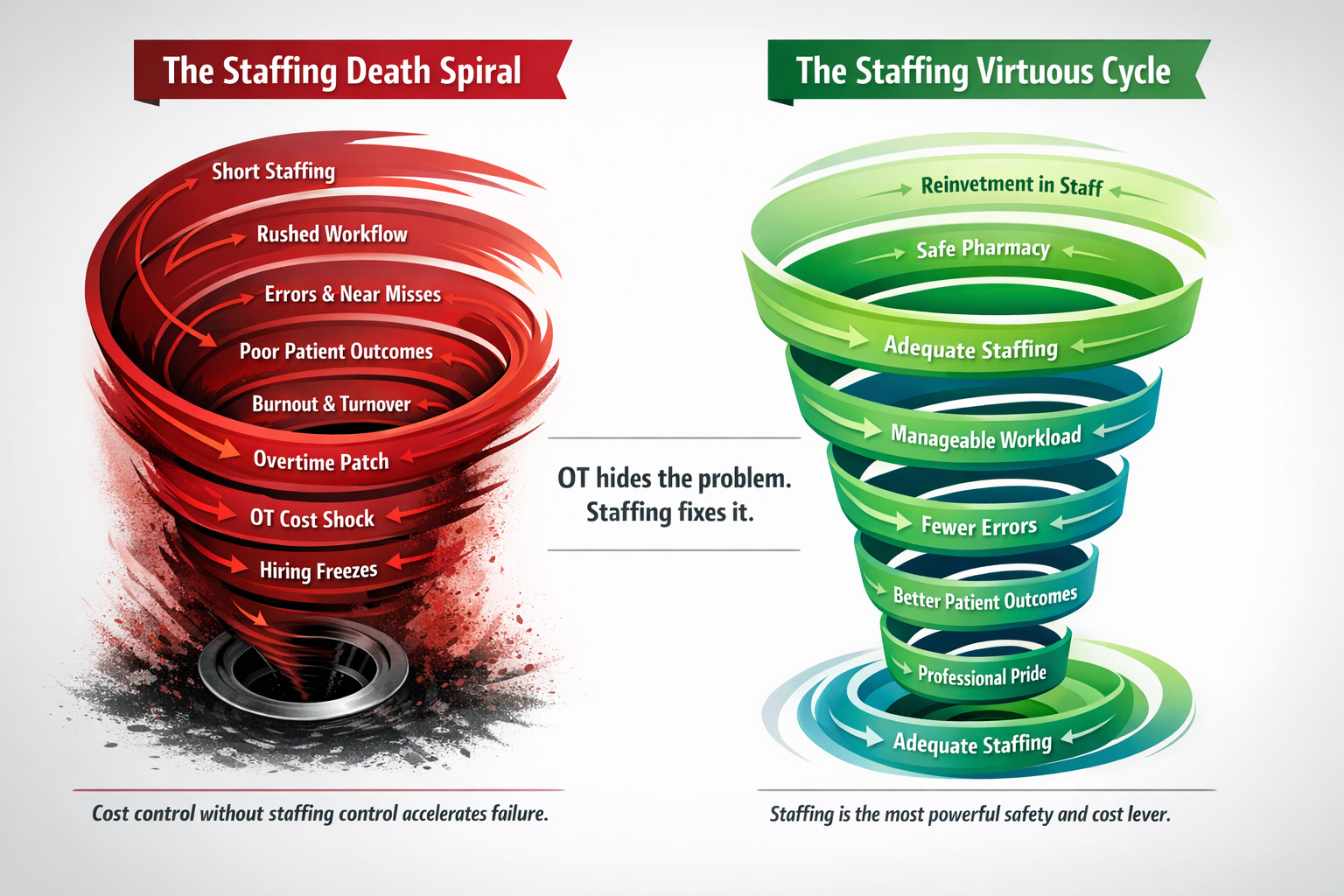
If you work in pharmacy, this image doesn’t feel abstract, it feels lived. Across retail, hospital, and health-system settings, pharmacy technicians are often caught in a cycle where short staffing leads to rushed workflows, rushed workflows increase errors and near misses, errors erode patient safety and trust, burnout accelerates, turnover rises, and overtime becomes the temporary fix. Eventually, costs spike, hiring freezes follow, and the cycle tightens even further. This isn’t a failure of dedication or work ethic. It’s a systems problem, one that relies too heavily on short-term patches instead of long-term solutions.
Pharmacy technicians are asked every day to do more with fewer resources, onboard new hires while already stretched thin, adapt to constant regulatory and technology changes, and remain patient-centered under intense time pressure. Overtime can hide these issues for a while, but it doesn’t resolve them. Research consistently shows that sustained understaffing and excessive workload are directly linked to higher error rates, increased turnover, and lower job satisfaction in pharmacy teams. At the same time, studies also show something encouraging: teams with adequate staffing, standardized training, and credentialed technicians experience fewer medication errors, stronger retention, and better patient outcomes.
The hopeful truth is that the cycle can be reversed. Adequate staffing creates manageable workloads. Manageable workloads reduce errors. Fewer errors improve patient outcomes. Better outcomes restore professional pride. Pride supports retention. Retention stabilizes staffing. Stability allows reinvestment in people. This “virtuous cycle” doesn’t happen by accident, it happens when organizations choose to invest upstream instead of reacting downstream.
Education plays a critical role in this shift. While education alone won’t solve staffing shortages, poor preparation almost guarantees they persist. Technicians who enter the workforce underprepared often require longer onboarding, place additional strain on experienced staff, and feel less confident navigating complex workflows. Conversely, technicians who are well trained, credentialed, and supported enter practice with confidence, contribute sooner, and help stabilize teams faster. Research has shown that structured training and credentialing are associated with improved accuracy, higher job satisfaction, and stronger professional identity among pharmacy technicians.
This is why education cannot be reduced to “passing an exam.” Education is about readiness. It’s about confidence under pressure. It’s about protecting patients, supporting colleagues, and sustaining the profession over time. At RxTechExam, our commitment as a PTCB-recognized education and training program is to prepare technicians not just to test well, but to practice well and to enter the workforce ready to contribute, learn, and grow. We see education as one of the earliest and most effective levers to strengthen pharmacy teams, reduce burnout, and improve outcomes.
Being a pharmacy technician can be demanding, and burnout is real. But so is progress. Investments in training, mentorship, staffing models, and professional recognition are showing measurable results across the industry. Technicians who feel prepared and valued are more likely to stay, advance, and advocate for their teams and patients. That matters, not just for individual careers, but for the health of our communities.
The staffing death spiral isn’t inevitable. Moving forward requires commitment, collaboration, and a willingness to invest in people early and intentionally. When we strengthen education, we strengthen teams. When we strengthen teams, we protect patients. And when we support pharmacy technicians, we build a profession capable of lasting well beyond the next shift.
Together we can. Together we will.
Wishing you continued success,
Dr. Abel Guevara III, CPhT-Adv
References
American Society of Health-System Pharmacists. (2022). ASHP national survey of pharmacy practice in hospital settings: Workforce and staffing. American Journal of Health-System Pharmacy, 79(14), 1152–1166. https://doi.org/10.1093/ajhp/zxac109
Health Resources and Services Administration. (2023). Health workforce projections: Allied health and pharmacy support occupations. U.S. Department of Health and Human Services. https://bhw.hrsa.gov
Institute for Safe Medication Practices. (2023). Workload, staffing, and safety in pharmacy practice. ISMP Medication Safety Alert. https://www.ismp.org
National Academy of Medicine. (2019). Taking action against clinician burnout: A systems approach to professional well-being. The National Academies Press. https://doi.org/10.17226/25521
Pharmacy Technician Certification Board. (2023). Role of credentialing in pharmacy technician workforce development. https://www.ptcb.org